The History of Bit2
Bit2 was born at Fairgate Labs in late 2025 during a brainstorming session involving Ariel Futoransky, Jonatan Altszul, and Sergio Demian Lerner, the company's three co-founders. However, the path that led to it began much earlier.
In October 2023, only two months after Fairgate Labs was founded, BitVM was introduced. For the first time, the prospect of building a Bitcoin Layer 2 with a trust-minimized bridge shifted from a distant vision to a concrete research and development effort. At that moment, the Fairgate founders—all early Bitcoiners—decided to pivot the company toward developing the best open-source trust-minimized bridging architecture for Bitcoin. That effort eventually became BitVMX, whose goal was to improve existing Bitcoin sidechains.
The original vision was to strengthen the entire Bitcoin ecosystem by making trust-minimized bridges practical, however, the advent of agentic commerce opened an exceptional opportunity to put Fargate's technology to work to improve Bitcoin even more.
From Machine Payments to Agentic Payment Networks
The history of agentic payments predates modern AI agents. HTTP/1.1 already included the status code 402 Payment Required, although it remained reserved for future use. Decades later, Bitcoin and payment-channel networks made machine-native payments practical. In 2020, Lightning Labs introduced L402—originally LSAT—to combine HTTP 402, Lightning payments, and authentication for paid APIs. In 2023, L402 was integrated with LangChain, demonstrating how AI agents could autonomously pay for online services.
The major inflection point came in 2024, when AI agents became capable of using tools, calling APIs, operating wallets, and executing multi-step workflows. Payment became a critical missing primitive: an agent that could discover a service but could not purchase it still required human intervention.
That year, Skyfire launched a payment network for AI agents, while Coinbase introduced AgentKit, giving agents programmable wallets capable of transfers, swaps, and smart-contract interactions.
In May 2025, Coinbase launched x402, reviving HTTP's 402 Payment Required code as an open payment protocol. A server can return machine-readable payment requirements, allowing an agent to pay—typically with stablecoins—and automatically retry the request. This model is particularly suitable for agents purchasing APIs, data, inference, or other digital services on demand.
Traditional payment networks soon entered the field. Mastercard Agent Pay and Visa Intelligent Commerce were announced in April 2025, focusing on safely delegating existing payment credentials to agents through tokenization, authentication, spending limits, and user controls.
By late 2025, agentic payments had evolved into a broader protocol stack. Google's AP2 addressed authorization and proof of user intent, while OpenAI and Stripe's Agentic Commerce Protocol (ACP) focused on interactions between agents, merchants, checkout systems, and fulfillment.
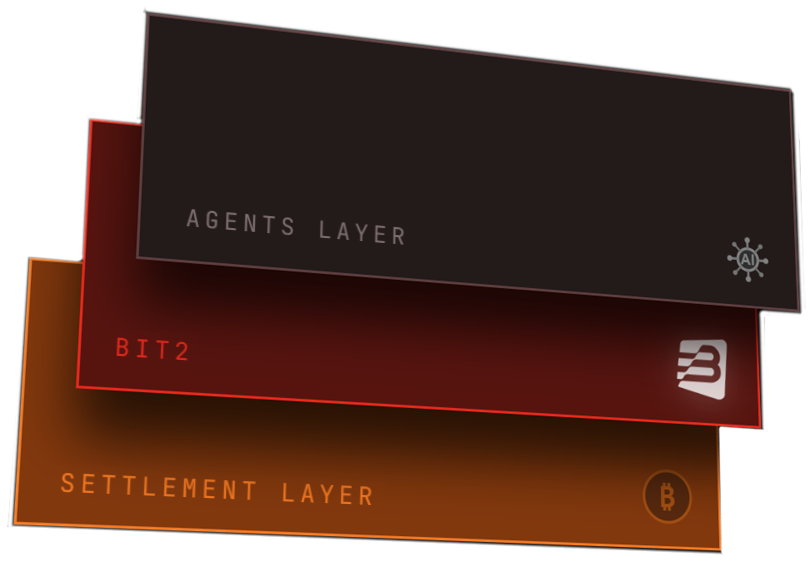
What emerged was not a single agentic payment network, but several complementary layers: settlement rails such as cards, stablecoins, and Lightning; payment protocols such as x402; and authorization, identity, and commerce protocols that determine what an agent may buy and how it interacts with merchants.
Agentic payments therefore represent more than an extension of e-commerce. They are an attempt to give autonomous software a native economic layer, enabling agents to discover, purchase, and eventually sell digital services without direct human intervention.
Advancing Bitcoin
into the
Agentic
Era
Bit2 is the economic layer for autonomous agents
Markets are operating continuously at scale, with agents emerging as independent economic
actors. This transformation requires infrastructure designed for autonomy — neutral, global, deterministic, and enforceable by design.
Bit2 provides the infrastructure for sovereign agents to transact trustlessly on Bitcoin.
The Search for a Better Agentic Payment Network
By mid 2025, Fairgate founders recognized this opportunity. A blockchain-based payment network was ideal to support a decentralized global machine economy, yet no existing decentralized blockchain Layer 1 or Layer 2 could process the hundreds of thousands—or eventually millions—of payments per second that such an ecosystem would require. While currently most agentic commerce runs on stablecoins, Fairgate's founders dream was to position Bitcoin as an alternative monetary asset in the agentic economy. Fairgate Labs conducted extensive analysis of the Lightning Network and the L401 protocol as an agentic payment network. The team analyzed transaction costs—including the hidden cost of permanently locked collateral—payment success probabilities, routing complexity, channel management overhead, liquidity requirements, payment latency, and mass-exit safety.
The conclusion was difficult to accept but impossible to ignore. The Lightning Network, despite its elegance and enormous contributions to Bitcoin, could not economically compete with centralized payment infrastructures such as Tempo or Base for the emerging agentic-commerce market. Either large centralized companies would dominate this new economy, or Bitcoin would require an entirely new Layer-2 architecture.
No existing protocol combined all the properties Fairgate considered essential:
- high scalability,
- an extremely small L1 footprint,
- no data-availability requirements,
- no liveness assumptions,
- confidential transactions,
- deterministic low-latency payments,
- and suitability for autonomous machine-to-machine commerce.
Fairgate decided it was time to build a new Bitcoin L2 for agentic commerce that supports both bitcoin and stablecoins natively, rethinking the design from first principles. The research team spent the following 6 months designing the right technology to underpin this new agentic payment network. Finally they converged on a radically new hyper-performant design based on Client-Side Validation (CSV).
Brief History of Client-side Validation
Client-Side Validation was introduced by Peter Todd in 2016. The original concepts can be found in his paper Scalable Single-Use Seal Asset Transfer. Although the core idea is elegant—users locally validate state transitions while the blockchain merely timestamps commitments—it remained largely unexplored for several years.
In hindsight, Client-Side Validation can be viewed as a fundamental shift in blockchain architecture. Instead of asking the blockchain to execute and validate every transaction, it treats the blockchain primarily as a global ordering and timestamping service, pushing most computation and state verification to the network edge.
Over the following years, two major families of CSV protocols emerged.
RGB was conceived as a scalable asset protocol built on top of Bitcoin. It introduced several important innovations, most notably AluVM, a virtual machine capable of executing client-side smart contracts.
INTMAX2, on the other hand, was designed primarily for Ethereum. It demonstrated that a client-side protocol could achieve an extremely small L1 footprint—roughly four bytes per Layer-2 transaction—without relying on a separate data-availability layer.
Each protocol contributed an important piece of the puzzle, but neither solved all of the problems simultaneously.
In 2025, another important protocol appeared: ShieldedCSV. Although many of its underlying ideas had circulated privately months before publication, ShieldedCSV became the first CSV protocol explicitly focused on confidential payments. It demonstrated that client-side validation could naturally support transaction privacy, although at the cost of relatively limited scalability—roughly an order of magnitude improvement over Bitcoin itself.
 FAIRGATE'S BIT2 RESOURCE HUB
Bit2 Project Kick-off
In the end of 2025, Fairgate finalized the architecture of what would become Bit2. One important realization was that scalability alone would not be sufficient. Autonomous agents require deterministic payments, programmable spending policies, cryptographic payment receipts, objective payment proofs, confidential transfers, and extremely low latency. These requirements gradually shaped Bit2 into much more than a payment network—they defined it as an execution layer for autonomous economic agents.
Bit2 was designed from the outset as a genuinely trust-minimized Layer 2 with special attention to emerging Agentic Economies. It eliminates the need for centralized sequencers, avoids central servers that store indispensable user data, and removes dependence on centralized payment-routing infrastructure.
In a nutshell, Bit2 provides high scalability (1600 raw transactions/s on Bitcoin, achieving >100k payments/second using batching, almost unlimited transfers/second using payment channels on top of Bit2). extremely small L1 footprint (4 bytes per transaction), no data-availability requirements, no liveness assumptions for normal users (BitVMX bridge operators still need to be live), confidential transactions (protecting source, destination, token amounts and almost all metadata), deterministic low-latency payments (<1s, using bonded-promises, 20 minute finality on Bitcoin), contractually-enforceable receipts, delegated wallets with payment restrictions (using client-side scripts), making it fully suitable for autonomous machine-to-machine commerce.
Bit2 Project Progress
During 2026, development progressed simultaneously on several complementary technologies: The BitVMX bridge, the Bit2 nodes, and the Bit2 integration to x402.
Fairgate expanded BitVMX with Garbled Circuit support, developed recursive STARK proving systems to accelerate client-side proving, and integrated zero-knowledge techniques into recursive STARKs to eliminate metadata leakage. Creating the most secure, efficient and decentralized bridge for Bit2 is essential to its success.
Beginning in April 2026, Fairgate started publishing a series of technical articles explaining why Client-Side Validation is likely the only architecture capable of scaling Bitcoin while preserving decentralization.
By August 2026, working proof-of-concepts already existed for many of Bit2's core components, including a Timestamp Service Provider, a Bit2 client, confidential transfer proofs, and an x402 payment gateway.
The next major milestone is the publication of Bit2's academic paper, planned by the end of 2026. Several mature components will then be released as open source and made available for public beta testing.
The goal is to build something even more important than the software itself. Bit2 is intended to become an open protocol, developed and governed by a decentralized community rather than a single company. Fairgate's ambition is not simply to launch another Bitcoin Layer 2, or even merely to contribute public-good payment infrastructure for the next generation of autonomous commerce. The larger goal is to bring payments back to the center of Bitcoin's mission by bringing millions of new users to Bitcoin—AI agents.
Conclusion
The history of Bit2 reflects two parallel technological revolutions.
The first was Bitcoin's evolution from a digital currency into a programmable settlement layer through innovations such as BitVM and Client-Side Validation. The second was the emergence of autonomous AI agents capable of participating directly in economic activity.
Bit2 was conceived where these two revolutions intersect.
Rather than adapting existing payment networks to a future they were never designed for, Fairgate chose to build a new architecture from the ground up—one optimized for scalability, privacy, self-custody, low latency, and machine-to-machine commerce.
Whether Bit2 ultimately succeeds will depend not only on its technology but also on the community that forms around it and an emerging ecosystem of interconnected merchant, client and p2p products. Like Bitcoin itself, its greatest strength may eventually come from becoming infrastructure that no single organization controls, yet everyone can build upon.