Bit2 and Transaction Cost for Agentic Commerce
The next generation of the internet will be driven by autonomous agents continuously exchanging value: software purchasing compute, devices paying for bandwidth, and AI services acquiring data in real time. In this environment, transaction cost is not just a matter of fees—it determines whether entire classes of economic activity are feasible. Systems that depend on scarce resources such as locked liquidity or expensive L1 bandwidth struggle to scale to millions of small, concurrent payments. Bit2 is designed to minimize these structural costs by combining client-side validation, commitment aggregation, and flexible service modes.
The L1 Data Footprint per L2 Transaction is a fundamental scalability metric because L2 security ultimately depends on anchoring data or commitments on the base layer. If each L2 transaction consumes many bytes on L1, the system becomes tightly coupled to L1 congestion and fee volatility. In contrast, systems that compress large volumes of transactions into minimal L1 data become largely decoupled from these constraints.
Bit2 consumes approximately 4 bytes of L1 space per L2 transaction (assuming a large number of transactions are time-stamped together). For comparison, optimistic rollups such as Base typically require tens of L1 bytes per L2 transaction (around ~40 bytes) due to data availability requirements. Client-side validated systems such as Shielded CSV require approximately 64 bytes per transaction.
Advancing Bitcoin
into the
Agentic
Era
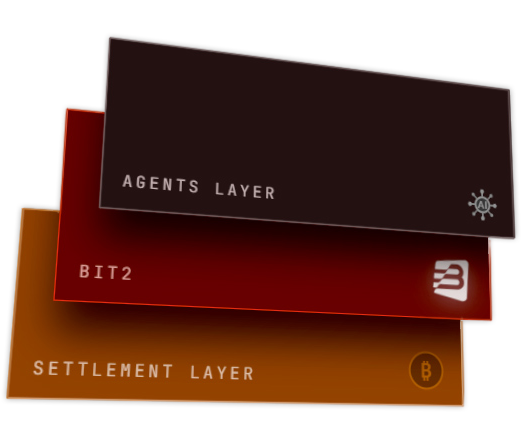
Bit2 is the economic layer for autonomous agents
Markets are operating continuously at scale, with agents emerging as independent economic
actors. This transformation requires infrastructure designed for autonomy — neutral, global, deterministic,
and enforceable by design.
Bit2 provides the infrastructure for sovereign agents to transact trustlessly on Bitcoin.
Stateless rollup designs such as INTMAX reduce this cost to roughly 4–5 bytes per transaction. The INTMAX FAQ states that “INTMAX offers greater scalability than centralized servers… transaction fees can remain as low as 0.5 cents in a highly predictable and stable way.” While the theoretical L1 footprint suggests that INTMAX transactions could be cheap, in practice current fees appear significantly higher than the implied L1 cost, likely reflecting operational overheads rather than pure data availability costs.
Protocols such as Ark can theoretically achieve even smaller L1 footprints because a fixed commitment can anchor an arbitrarily large number of off-chain transactions. However, once the footprint is reduced to just a few bytes—or less—further reductions yield diminishing economic returns. At that point, scalability bottlenecks shift away from L1 bandwidth toward collateral cost, computation, networking, or service throughput.
The Lightning Network presents a different trade-off. Its L1 footprint is indirect, arising from channel management operations such as openings, closures, rebalancing, and top-ups. Using a commonly cited industry ratio of roughly 100:1 off-chain to on-chain transactions, Lightning’s effective L1 footprint can be estimated at several tens of bytes per payment. This creates a structural dependency on L1 activity that grows with network usage and channel churn.
Average Transaction Fee
Average Transaction Fee measures the typical cost paid to execute a payment. For agentic commerce, this metric is critical: if fees are high or unpredictable, many automated interactions—such as paying for milliseconds of compute or microservices—become economically infeasible.
In Bit2, transaction fees remain extremely low because the only scarce resource consumed is the occasional L1 commitment, whose cost is amortized across a large number of payments. Thousands or even millions of transactions can share a single commitment, reducing the effective cost per payment to a fraction of the underlying L1 fee.
Time-stamping services generate zero-knowledge proofs (SNARKs) to validate state transitions, and one proof is published per commitment. However, this cost is also amortized across all included transactions. Modern proof systems allow massive parallelization using GPUs, further reducing the marginal cost per payment.
In contrast, Lightning and Ark must recover the opportunity cost of locked liquidity through routing or service fees. Rollups such as Base must continuously pay for publishing transaction data on L1. As a result, their fees remain structurally tied either to capital costs or to L1 blockspace prices.
Bit2 decouples transaction cost from both factors: it does not require persistent liquidity lockups, and it minimizes L1 data consumption to near-zero levels.
Conclusion
Transaction cost is not just an implementation detail—it defines the limits of what a payment system can support. Systems that depend on liquidity provisioning or significant L1 bandwidth inherit structural constraints that become critical under high concurrency and small payment sizes.
Bit2 addresses these limitations by combining client-side validation with extreme data compression and flexible service modes. As a result, Bit2 is not simply a lower-cost alternative—it represents a shift in how payment systems scale. By removing dependence on both locked capital and L1 data availability, it enables a class of high-frequency, low-value, agent-driven transactions that other architectures struggle to support.