


Computing on Bitcoin #90
May 22, 2026 - Week 21
Research around Bitcoin-native verification, privacy, and interoperability keeps moving forward, with new proposals pushing the frontier.
Here's a selection of recent articles and developments shaping the next generation of Bitcoin infrastructure.
Let's dive in!
A new presentation from Bitcoin 2026 by Ying Tong Lai, Liam Eagen, and Robin Linus explores Argo garbling, BitVM bridges, and Shielded CSV as approaches for improving Bitcoin privacy and scalability.
Argo Garbling Scheme,BitVM Bridges & Shielded CSV | Bitcoin 2026
youtube.com/@BitcoinMagazine
Ying Tong Lai, Liam Eagen, and Robin Linus of {ideal} present Shielded CSV, a client-side validation protocol that offers Zcash-level privacy and roughly 20x the throughput of Bitcoin without requiring a soft fork.
A new article by Torben Poguntke from Input Output Global discusses Pogun’s Bitcoin DeFi architecture and its approach to trust-minimized bridging. The post outlines production challenges around BitVM3 garbled circuits and alternative verification designs.
iog.io/news
🔗
Why Pogun's Bitcoin DeFi architecture is achievable

Pogun's technical team built Cardinal, Input Output (IO)'s open-source Bitcoin bridge specification, on BitVMX. Cardinal demonstrated the core mechanism live on the Bitcoin mainnet at Bitcoin 2025. That experience surfaced where the BitVM family's production constraints sit and where each iteration can and cannot carry weight at scale.
A new research paper by Ramses Fernandez presents a formal analysis of Fairgate Labs' FLEX and FLEX2, protocols designed for BitVM-style dispute systems and cross-chain bridges.
eprint.iacr.org
🔗
A FORMAL ANALYSIS OF FLEX AND FLEX2

FLEX protocol emerges as an important advancement, designed specifically to ease capital-efficient optimistic bridges on Bitcoin through the implementation of on-demand security bonds.
A new proposal introduces Kapow (Kheckpoint-Anchored Proof-of-Work), a mechanism designed to anchor Liquid checkpoints to Bitcoin for stronger finality guarantees. The proposal outlines how Bitcoin-backed checkpoints could strengthen BitVM-based bridges by reducing risks associated with consensus reorganization and aligning with 1-of-n trust assumptions.
gist.github.com
🔗
💥 Kapow: Bitcoin Finality Guarantees for the Liquid Network
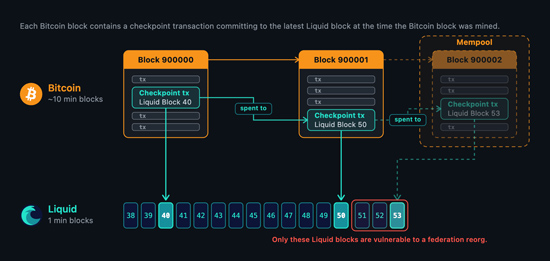
Liquid's original design made a sensible tradeoff: since the peg itself depended on a federation with an honest-majority trust assumption, Liquid consensus could also depend on the same federation. Adding a separate proof-of-work or merge-mined consensus layer would have added complexity without removing the dominant trust assumption, because BTC custody still depended on the federation.
Thanks for reading this latest edition of Computing on Botcoin News!
Make sure to stay tuned for our curated selection every week.
Until next week,
The Fairgate Team