


Computing on Bitcoin #110
October 09, 2026 - Week 41
Welcome to a new edition of Computing on Bitcoin News! Let's dive into this week's selection.
A new post featuring Rootstock co-founder Sergio Lerner discusses scaling Bitcoin through additional layers rather than larger blocks, highlighting BitVM and BitVMX as approaches to more decentralized Bitcoin bridges.
x.com/rootstock_io
🔗
Bitcoin doesn’t need to do everything

@RootstockLabs Co-founder and Scientific Advisor Sergio Lerner has been thinking about how to extend Bitcoin for a long time.
But his idea of “scaling Bitcoin” is not bigger blocks, more transactions, or pushing more computation onto Bitcoin itself.
It is almost the opposite.
Robin Linus released two whiteboard sessions comparing Glass Coins and Shielded Bitcoin, covering key architectural tradeoffs and comparing BitVM and PIPEs as approaches to Bitcoin bridging and future upgrades.
The crux of shielded Bitcoin protocols like @ShieldedCSV isn't the private transfer. It's the bridge. Shield in. Unshield out.
— Robin Linus (@robin_linus) October 3, 2026
So what are the real options? pic.twitter.com/CFNkdhlhmy
I filmed a whiteboard session...
— Robin Linus (@robin_linus) September 27, 2026
GLASS COINS vs SHIELDED BITCOIN
∙ Key architecture and metaprotocol tradeoffs
∙ BitVM vs PIPEs (full comp of bridges)
∙ Cutting through delusion: the case for Bitcoin upgrades pic.twitter.com/H4PkO8V9Ws
A new paper introduces LN-GAP, a Lightning-based framework for arbitrary offchain computation with O(1) onchain dispute resolution, discussing its relationship to BitVM, BitVMX and trust-minimized Bitcoin contracts.
github.com/AdamISZ
🔗
LN-GAP: Lightning governed by arbitrary programs
We propose, without any consensus change to Bitcoin, offchain bilateral contracts in Bitcoin that depend on arbitrary computation, calling this general paradigm LN-GAP (Lightning Network governed by arbitrary programs). That general idea is not new but we describe here a distinct mechanism to achieve O(1)-transactions to resolve disputed contracts onchain (that is, there is no onchain bisection).
A new article examines BitVM as a Bitcoin scaling approach, covering the BitVM2 architecture refined from Robin Linus's original design, SNARK verifiers, Taproot logic gates and optimistic dispute games. It describes how these bring general-purpose computation and ZK validity verification to Bitcoin without a soft fork.
investors-planet.com
🔗
BitVM Bitcoin Scaling: Zero-Knowledge Verification on Layer 1
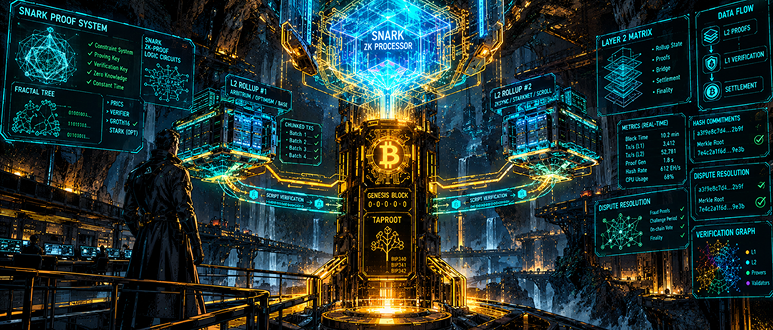
Bitcoin’s architectural simplicity has long served as its greatest security asset. By deliberately eschewing the expressive, stateful virtual machines of modern smart contract platforms, Bitcoin prioritized consensus stability, minimal attack surface area, and absolute predictability. Bitcoin Script—its native execution language—is intentionally non-Turing-complete, lacking native loops, arbitrary state transitions, or dynamic execution environments.
That's all for this week's Computing on Bitcoin News. Thanks for following along as we continue exploring the research and innovations shaping Bitcoin's future.
Until next time,
The Fairgate Team